Fire Breath
Feel the warmth build. Not from the outside, but from within.
Fire Breath, also known as Agni Pranayama, is a Kundalini Yoga pranayama designed to ignite inner energy, clear stagnation, and awaken mental clarity through fast, rhythmic breathing powered from the core. It’s a breath that moves like a steady flame.
strong but controlled. rising without force, illuminating from the inside out.
Quick Overview
who it’s for
For those looking to clear mental fog, reset breath rhythm, and reawaken clarity from the inside out. Best suited for practitioners with some familiarity with breath control and body awareness.
when to practice
Morning or early day
Before meditation
After breath-holding or asana
As a short clearing technique, not for long durations
Always follow with restorative breath or stillness to observe the effect.
why it matters
When the breath clears, the mind brightens. Each sharp exhale acts like a reset button… pulsing the diaphragm, moving stuck energy, and creating space for inner lightness, clarity, and calm.
core benefits
With regular, mindful practice, Breath of Fire can help:
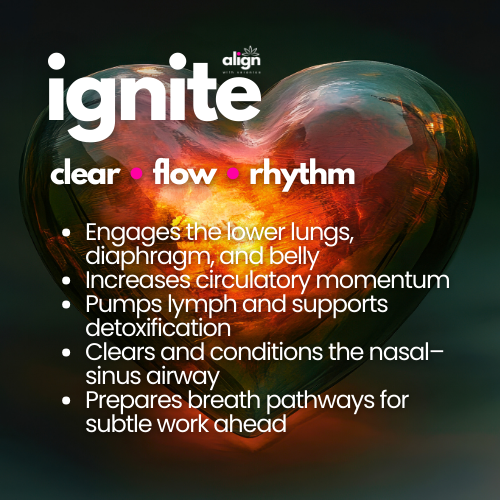
Awaken and energize the mind
Ignite internal clarity and awaken mental brightness without overstimulation.Support circulation, detox, and warmth
Rhythmic diaphragm movement boosts circulation, warms the body, and creates subtle abdominal pressure shifts that support lymphatic flow • helping move waste and fluid upward through the body.Clear and prepare the nasal passages
Improves airflow and sinus clearing, optimizing the breath pathways for deeper practices like Bee Breath or Ocean Breath that rely on nitric oxide resonance.Train breath rhythm and postural awareness
Strengthens core breath mechanics, improves nasal posture, and supports CO₂ tolerance • laying the foundation for healthy respiratory chemistry.Develop diaphragmatic strength and tone
Reinforces low-belly breathing and active exhalation, building a stronger, more responsive breath engine.
more subtle benefits may include •
Improved heart–breath rhythm
Encourages entrainment between the respiratory and cardiovascular systems.Enhanced nitric oxide delivery
While not a direct NO-generator, Fire Breath clears the canvas: improving nasal flow and breath posture so nitric oxide–rich practices can deliver greater effect.Greater interoception + focus
Trains moment-to-moment awareness of the breath, helping you return to center in daily life.Energetic priming of the nadis
Prepares the subtle energy channels for more refined pranayama work through rhythmic activation and pressure regulation.
Think of it as your brain’s breath-based reset button.
what is fire breath
Fire Breath is a nasal-only, diaphragmatic breath done in a rapid, rhythmic pattern, with equal inhale and exhale length, and a slight emphasis on the exhale.
Inhale = Active but gentle (not forceful)
Exhale = Slightly stronger, rhythmic pulse
Diaphragm + belly pulse like a rhythmic engine
Breath is continuous, without long holds or sharp bursts
It feels like a core-driven drumbeat, syncing breath and body into focused momentum.
yogic roots
In yoga philosophy, Agni is the inner fire. The transformational force that governs digestion, metabolism, and clarity. Fire Breath stokes this fire, not with strain, but with intentional rhythm and presence.
You’re not forcing the fire… you’re feeding it
Modern Insight
physiological effects
Fire Breath has been studied for its ability to:
Stimulate the sympathetic nervous system (temporarily), followed by a regulated parasympathetic reset
Improve core strength and diaphragm activation
Enhance circulation and oxygen delivery through rhythmic pressure changes
Support mental focus and clarity through cortical activation
Boost mood by increasing endorphins and neurochemical circulation
A short round may leave you bright-eyed, warm, and grounded… fully present.
about nitric oxide •
While Fire Breath doesn’t directly boost nitric oxide like humming techniques (e.g., Bee Breath), it clears nasal pathways, strengthens breath control, and primes the system for oxygen–CO₂ balance, which supports overall nitric oxide signaling when practiced properly.
Think of it as fueling the circuit, preparing the breath-body system for deeper interoceptive awareness.
how to practice breath of fire
step by step •
Sit Comfortably • Sit tall, stable, relaxed (spine aligned, shoulders soft, jaw relaxed, lips gently sealed)
Inhale Gently Through the Nose • Allow a natural inhale to fill the lungs. Let the belly expand slightly
Exhale Sharply Through the Nose • Contract the belly quickly, pushing air out with force.
Passive Inhale • Let the inhale happen passively without strain
Continue the Rhythm •Practice short, rapid exhales at a steady pace (about 1–2 breaths per second)
Practice 20–30 rhythmic rounds, pause, then repeat for 2–3 cycles
tips •
Begin with 20–30 seconds (or ~30 breaths), then pause
Complete 1–3 rounds, resting between
Keep the face, jaw, throat, and chest relaxed
Breath should feel even, steady, and controlled, not sharp
Use diaphragm and core
Follow with a cooling breath or stillness
Rest between cycles to avoid dizziness
Focus on the exhale. The inhale happens passively.
Practice on an empty stomach, ideally in the morning for an energizing start.
steady rhythm • strong center • soft gaze
signs this breath may serve you
You feel dull, heavy, or low-energy
You want to energize naturally without overstimulation
You need a focus reset before meditation or creative work
You’re training internal heat and breath-body awareness
You want to shift from passive to active attention
safety notes
avoid or modify if you have •
High blood pressure
Heart conditions
Pregnancy (unless guided by a teacher)
Epilepsy or seizure history
Recent abdominal surgery or active inflammation
Respiratory disorders (unless adapted gently)
stop if you feel •
Lightheaded or dizzy
Overheated
Overstimulated or breathless
Always honour your body’s signals. Short rounds over strained rounds.
off-the-mat reminder
More important than perfect technique is awareness during the day. As you breathe through your nose, relax your tongue to its natural home on the roof of the mouth, and steady your posture, you are training your sleep-state breath too.
closing thought
Fire Breath is a reminder that your breath is both medicine and fuel. With each sharp exhale, you clear what no longer serves and ignite the fire of vitality within.
Small daily training leads to big systemic change.
Fire Breath teaches us that inner power doesn’t come from pushing harder. It comes from rhythm, presence, and intention.
the interconnectedness of breath
Balanced Breath, Bee Breath, and Fire Breath (and others) all work together as part of a larger system of well-being. Adjusting tongue posture, breathing rhythm, hydration, sleep position, stress load, and CO₂ tolerance may all influence sleep and daily energy.
Mindfulness helps you see the interplay, and the breath lets you gently retrain it.
Have you tried Fire Breath before? How does it shift your energy and focus?