Alternate Nostril Breath Without Retention
anulom vilom
Anulom Viloma (Alternate Nostril Breath) is one of the most widely practiced breath techniques in modern yoga, and one of the most commonly misunderstood.
Often conflated with Nadi Shodhana, Anuloma Viloma is a distinct practice with a different intention and effect.
While both involve alternating nostrils, Anulom Vilom is practiced without breath retention or energetic locks.
That difference matters.
deeping your breathwork practice
Anulom Vilom is often taught as a “basic” breath practice, yet for many people it is introduced too early, without context or appreciation for the added layers of coordination and awareness it requires.
While Anulom Vilom does not include breath retention, it does include direction, alternation, and mudra. This makes it both balancing and subtly complex, especially for those new to breath awareness or nervous-system regulation.
For this reason, Anulom Vilom is not where I begin.
It is where I deepen.
why i don’t start here
Before asking the nervous system to coordinate:
left and right nostrils
alternating airflow
hand placement (mudra)
focused attention
The body needs to first feel safe, steady, and oriented.
Many people arrive to breathwork already living in sympathetic dominance… busy, vigilant, overstimulated, and disconnected from subtle sensation. Adding complexity too soon can feel confusing or effortful rather than grounding.
So, before Anulom Vilom, I establish relationship.
anulom vilom
a calming breath to balance the mind and body
Imagine drawing a gentle figure eight with your breath. Flowing in one side, out the other, and back again.
This is the essence of Alternate Nostril Breathing without retention, traditionally known as Anulom Vilom.
It’s a smooth, non-holding breath practice that balances brain hemispheres, soothes the nervous system, and creates a steady rhythm of calm.
Unlike more advanced versions, like Nadi Shodhana (which includes breath retention), this variation offers a softer entry point into breath awareness.
No breath holds… just flow, rhythm, and clarity.
Instead, the practice emphasizes:
steadiness
symmetry
awareness of rhythm
easeful regulation
It is best understood as a balancing and preparatory breath practice, rather than classical pranayama.
what it does in the mind & body
how it works •
nervous system regulation
attentional balance
gentle harmonization of left and right hemispheres
common effects •
calming mental fluctuations
supporting focus without strain
improving breath awareness
creating a sense of internal steadiness
subtle effects •
Greater breath awareness without force
Interoceptive sensitivity (mind-body connection)
A foundation for breath holds and meditative practices
Gentle nervous system training for safety and resilience
supportive for •
beginners ready for deepening
periods of stress or fatigue
preparation for meditation or stillness
why it’s often more appropriate than retentive practices
In classical hatha yoga, retention amplifies internal states. Without sufficient grounding and stability, this amplification can overwhelm the system.
anulom vilom offers a way to •
balance before intensifying
educate the breath without forcing change
build trust in the nervous system
It teaches rhythm before retention, which is essential.
why alternate nostril breathing is powerful
This practice works by channeling the breath alternately through the right and left nostrils, each of which connects to different aspects of the central nervous system:
The right nostril (Pingala Nadi) is linked with solar energy, focus, and activation.
The left nostril (Ida Nadi) is linked with lunar energy, calmness, cooling, and introspection.
By balancing these two flows, Alternate Nostril Breathing harmonizes the sympathetic (fight-or-flight) and parasympathetic (rest-and-digest) systems.
a breath-based reminder of rhythm
This breath begins where we often forget to start… with inwardness.
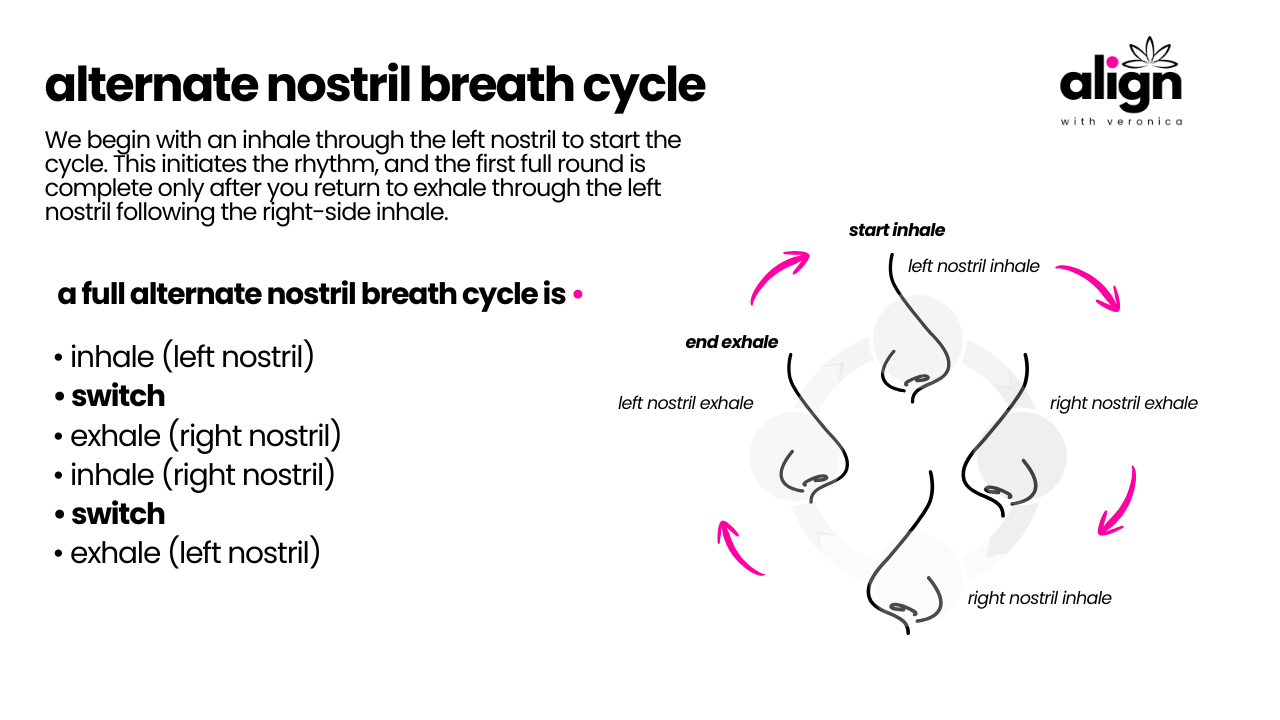
We inhale first through the left nostril, traditionally associated with the Ida nadi (the cooling, lunar, feminine channel), which represents intuition, calm, and inner reflection.
Then, we cross the threshold, the switch, and exhale through the right nostril, activating Pingala nadi (the warming, solar, masculine energy) of outward focus, action, and clarity.
The cycle continues, with the inhale through the right inviting vitality, and the final exhale back through the left bringing us full circle, into integration, rest, and closure.
This is not just a breathing pattern. It’s a mirror of your day:
Begin with presence and softness
Move through purpose and expression
Return to grounding, release, and quiet insight
Breath becomes a ritual of remembrance:
That we are always in cycle. That exhale follows inhale. That action follows stillness. And that we are made of both.
You might notice
one side feels more open
As you practice, you may realize that one nostril feels clearer than the other.
This is due to the nasal cycle. Your body’s natural rhythm of alternating nostril dominance every few hours. It’s completely normal and is connected to your autonomic nervous system.
You can read more here: Nasal Cycle Awareness
Rather than trying to force balance, use this breath to gently work with your body’s rhythm.
how to practice
anulom vilom • alternate nostril breath • no holds
1. Sit Comfortably
Find a stable, upright seat. Lengthen through the spine, soften the shoulders.
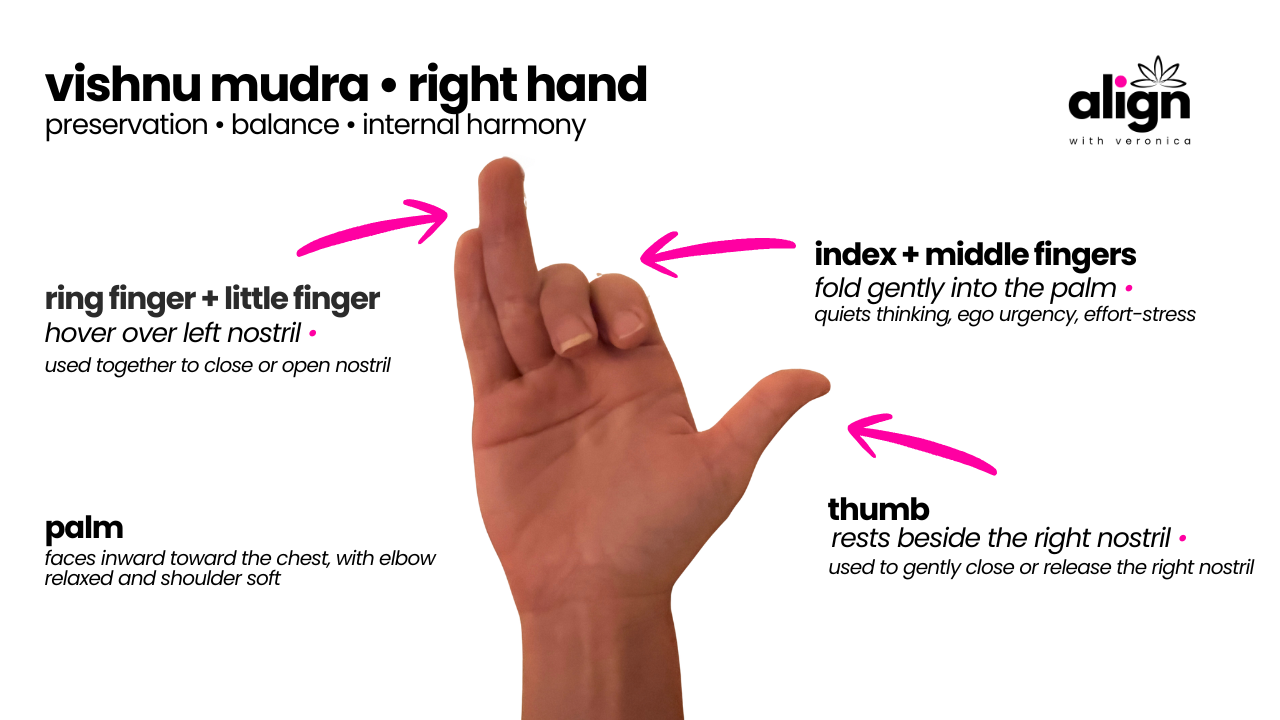
2. Form Vishnu Mudra • right hand
Fold the index and middle fingers toward the palm
Use the thumb to close the right nostril
Use the ring and pinky fingers to close the left nostril
3. Begin the Breathing Cycle
The pattern flows as •
Inhale (Left) → Exhale (Right) → Inhale (Right) → Exhale (Left)
step-by-step rhythm
• Inhale Left Nostril
– Close the right nostril with the thumb
– Breathe in slowly through the left
• Switch + Exhale Right Nostril
– Release the thumb
– Close the left nostril with ring and pinky
– Breathe out through the right
• Inhale Right Nostril
– Keep the left nostril closed
– Breathe in slowly through the right
• Switch + Exhale Left Nostril
– Release the ring and pinky
– Close the right nostril with the thumb
– Breathe out through the left
repeat the cycle
Continue for 5–10 rounds, breathing smoothly and gently.
Let the rhythm guide your awareness, balancing your inner landscape.
tips •
Keep your breath smooth, not forceful
Let the transitions between nostrils be seamless
Practice on an empty stomach or between meals
Start with 2–3 minutes, building to 5 minutes with consistent time and practice.
why practice
This breath reconnects you to balance, not by forcing it, but by remembering it. Each round is a moment of return. Inhale, switch, exhale, inhale, switch, exhale, repeat. A loop that brings mind and body into rhythm.
a teaching reflection
If you are a teacher, Anuloma-Viloma is often labeled “beginner-friendly,” but only when:
it is placed correctly
it is not rushed
it is not confused with classical pranayama involving retention
When taught with preparation, it becomes one of the most valuable practices for building pranayama literacy.
It teaches balance not by force, but by relationship.
safety notes
Start with Anulom Vilom (no retention) before progressing to Nadi Shodhana with holds.
Always practice gently, without strain.
If one nostril feels blocked, try a few minutes of regular breathing before beginning.
closing reflection
Before we ask the breath to move energy, we must teach it how to move steadily. Before we balance the channels, we must balance attention.
Anulom Vilom is not the beginning of breathwork… it is the moment breathwork becomes intentional. And when intention is present, prana learns to move without strain.
related practices
Looking for the advanced form of this breath? Try: Nadi Shodhana (with Retention)
Curious about nostril flow patterns? Read: Nasal Cycle Awareness
new to breath holds?
start with box breathing •
If you’re brand new to kumbhaka (breath retention), beginning with a simple, symmetrical pattern can help you gain comfort without the added complexity of switching nostrils.
Box Breathing teaches you to:
explore easy holds at the top and bottom of the breath,
develop smooth, even breath pacing,
feel the inner stillness of kumbhaka without hand coordination,
create safety and stability before moving into Nadi Shodhana.
Box Breathing for Calm, Focus, and Resilience
want to understand the purpose of each hold?
To use breath retention with intention rather than habit, it helps to understand the physiology and effects of the practice.